
Primary Types of Spray Insulation
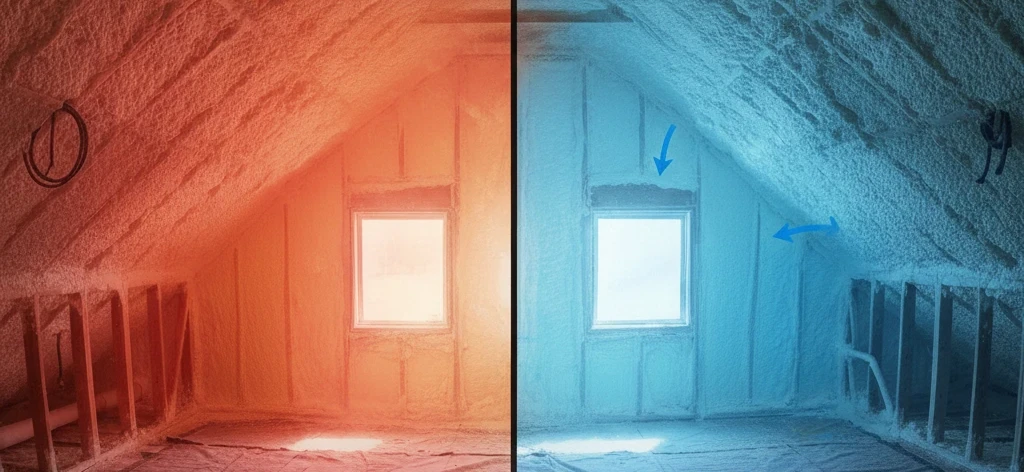
Two main categories dominate the market:
- Open-Cell Spray Foam Features lower density (typically 0.4–0.8 lb/ft³) and a softer, more flexible structure. It offers an R-value of approximately R-3.5 to R-3.8 per inch and excels in sound absorption and air sealing for interior applications. This type remains vapor-permeable, making it suitable for vented attics and wall cavities where moisture management is less critical.
- Closed-Cell Spray Foam Exhibits higher density (approximately 1.8–2.0 lb/ft³) and a rigid form. It delivers a superior R-value of R-6 to R-7 per inch and functions as a built-in vapor barrier, providing enhanced moisture resistance and structural reinforcement. Closed-cell foam is preferred for exterior walls, basements, crawl spaces, unvented attics, and roofs.
Additional variations include medium-density and high-density formulations tailored to specific performance needs, though open- and closed-cell remain the most prevalent.
Spray foam insulation cost calculator
Feel free to use our Calculator to get an estimate for your insulation services. Simply fill out new form and get an INSTANT ESTIMATE QUOTE for your project. You can even email it to yourself, if you would like to keep if for your records.
What are you insulating?
What type of Spray Foam?
How many Sq.Ft?
Estimated Total:-
Primary Benefits of Spray Insulation
Spray insulation offers several advantages over conventional materials:
- Creates an effective air barrier that minimizes drafts and heat loss or gain.
- Achieves high thermal resistance per inch, enabling efficient insulation in confined spaces.
- Reduces energy consumption, often yielding 5–30% savings on heating and cooling costs.
- Provides moisture control and mold resistance (particularly closed-cell variants).
- Enhances acoustic performance by dampening sound transmission.
- Conforms precisely to irregular surfaces, eliminating gaps common in batt or blown-in insulation.
- Contributes to long-term building durability without settling or degradation over time.
These attributes support compliance with energy codes and promote sustainable building practices.
Common Applications
Spray insulation is versatile and applied in:
- Attics (vented or unvented roof decks).
- Exterior and interior walls.
- Basements and crawl spaces.
- Rim joists and rim bands.
- Roofs and under-floor systems.
- Commercial envelopes and retrofits.
Professional application ensures uniform coverage and adherence to safety and performance standards.
Cost Overview
Installed costs for spray insulation vary by type, thickness, project scale, and location. National averages in the United States include:
- Open-Cell: $0.45 to $1.60 per board foot (commonly $0.60 to $1.00).
- Closed-Cell: $1.00 to $3.10 per board foot (commonly $1.30 to $2.50).
Per square foot (factoring typical thicknesses): $1.50 to $5.00 or higher. Residential projects typically range from $1,500 to $8,000, with averages around $2,800 to $3,500 for standard scopes. Minimum job fees often apply ($1,000 to $2,000).
For precise estimates, a site-specific evaluation is recommended.
Professional Installation Recommendations
Effective performance requires specialized equipment, precise chemical ratios, and safety measures. A certified spray foam insulation contractor ensures code compliance, proper ventilation during application, and manufacturer-backed warranties. Search for spray foam insulation near me to identify qualified local experts and request a no-obligation spray foam quote.
Get Your Free Spray Foam Quote Today
Investing in spray foam insulation for your attic is one of the most impactful ways to boost energy efficiency, enhance comfort, and protect your home. Contact a reputable spray foam insulation contractor for a thorough evaluation and personalized spray foam quote—no obligation required.
Frequently Asked Questions About Spray Insulation
-
What distinguishes open-cell from closed-cell spray insulation?
Open-cell is lighter, more flexible, and vapor-permeable with strong sound-dampening qualities, while closed-cell is denser, rigid, and provides a vapor barrier with higher thermal resistance per inch.
-
What is the typical cost range for spray insulation installation?
Costs average $0.45 to $3.10 per board foot installed, depending on type, with total residential projects often between $1,500 and $8,000.
-
Why is spray insulation preferred over traditional options?
It delivers superior air sealing, conforms to complex geometries, and offers long-term energy savings and moisture protection that outperform fiberglass or cellulose in many scenarios.
-
Is spray insulation suitable for DIY projects?
Small-scale applications may use canned kits, but professional installation is strongly advised for larger areas to achieve optimal performance, safety, and warranty coverage.
-
How can one locate a reliable provider for spray insulation?
Seek contractors with certifications (e.g., from the Spray Polyurethane Foam Alliance), licensing, insurance, and verified experience. Obtain multiple spray foam quotes and review references prior to selection.
Contact Us
Leave your inquiry, and we will get in touch with you! Or come visit us
Our Address
370 New Brunswick Ave Ste 234 Fords, NJ 08863
Our Email
absolutespf@gmail.com
Our Phone
855-937-0666